

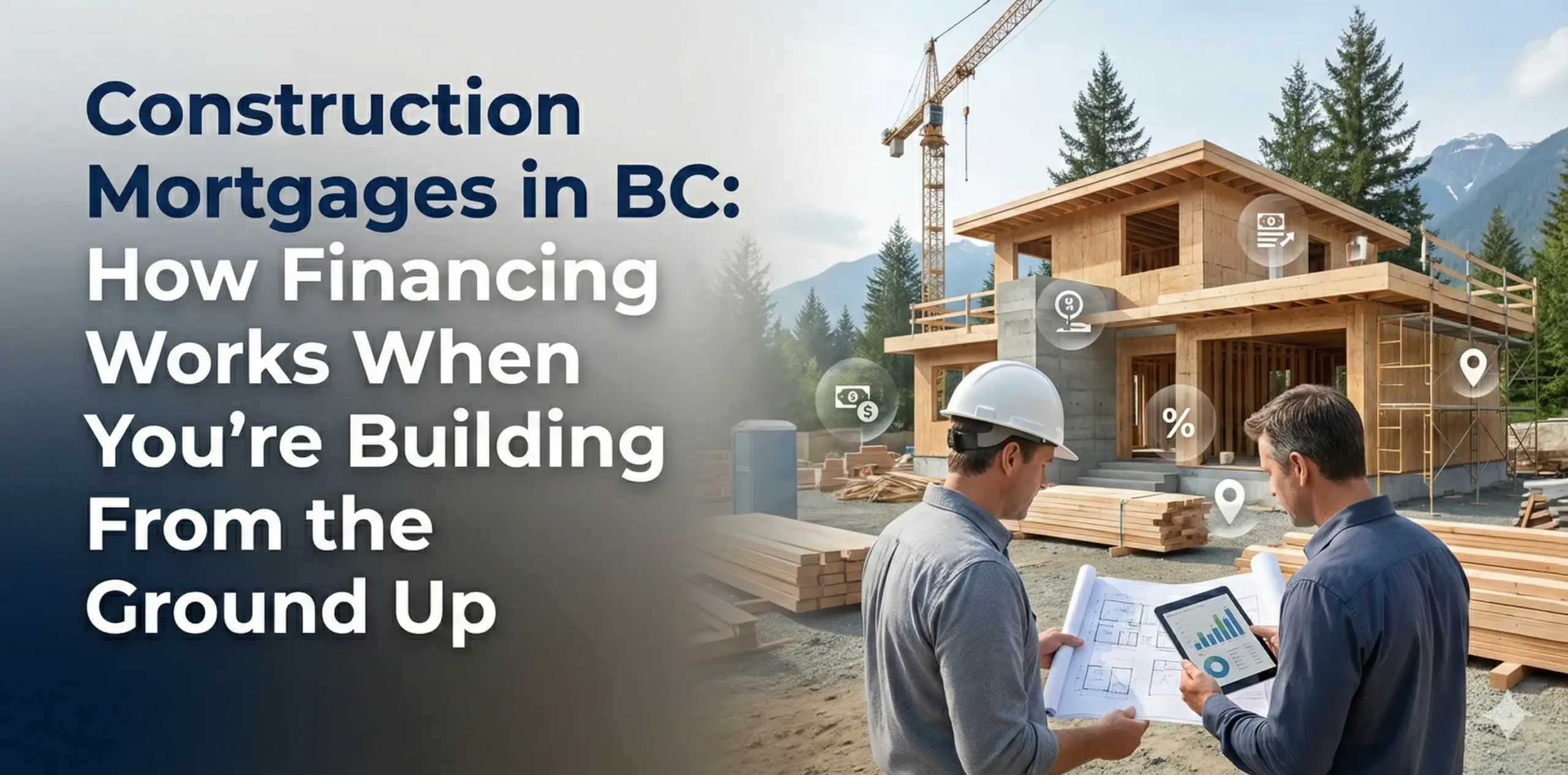
14 Feb Construction Mortgages in BC: How Financing Works When You’re Building From the Ground Up
Building your own home is one of the most rewarding ways to enter the housing market in British Columbia. Instead of competing in bidding wars for resale homes, many buyers are choosing to design and build from scratch — customizing layout, energy efficiency, rental suites, and long-term livability.
But financing a construction project is very different from getting a regular mortgage.
In 2026, construction costs remain elevated, labour availability is tight, municipal approvals take time, and lenders apply far stricter rules than for resale homes. Many buyers only discover this after they’ve already purchased land — when financing suddenly becomes complicated or delayed.
This guide explains exactly how construction mortgages work in BC, who qualifies, how draw schedules function, what lenders look for, and how to avoid the most expensive mistakes when building in markets like Surrey, Abbotsford, Langley, Mission, and across the Fraser Valley.
What Is a Construction Mortgage in BC?
A construction mortgage is a short-term, stage-funded loan designed specifically to finance the building of a home or multi-unit property. Unlike a standard mortgage where the full amount is advanced on closing day, construction financing is released in phases (called “draws”) as the build progresses.
Construction mortgages typically cover:
- Land purchase (if included in the same file)
- Foundation and framing
- Lock-up (roof, windows, doors)
- Interior finishing
- Final completion
Once the home is complete, the construction loan is usually converted into a standard long-term mortgage.
Why Construction Mortgages Are More Complex Than Regular Mortgages
With resale homes, the property already exists as lender security. With construction, the lender must finance a project-in-progress, carrying risk related to:
- Cost overruns
- Contractor delays
- Labour shortages
- Weather delays
- Permit complications
- Market value fluctuations
- Borrower income stability during the build
Because of this, lenders require far more documentation, higher down payments, and closer monitoring throughout the project.
The Two Main Types of Construction Financing in BC
1. Owner-Occupied Construction Mortgage
This is for individuals building their primary residence.
Typical features:
- Lower interest rates than investor builds
- More flexible long-term conversion options
- Can include rental suite planning
- Must meet end-user qualification rules
- Builder & Investor Construction Financing
This applies to:
- Spec builders
- Small multi-family developments
- Basement suite income projects
- Duplex/triplex builds
Investor-focused construction financing has:
- Stricter cash-flow review
- Higher equity requirements
- Shorter terms
- Stronger exit requirements
How Construction Mortgage Funding Works (The Draw System)
Funds are released in stages based on construction milestones:
Typical Draw Schedule:
- Initial Advance (Land or Foundation)
- Covers land purchase or foundation work
- Usually 50–65% of land value funded
- Framing & Lock-Up Stage
- Home is structurally enclosed
- Roof, windows, doors installed
- Mechanical & Interior Work
- Plumbing, electrical, drywall, insulation
- Final Completion
- Occupancy permit issued
- Landscaping, driveways, finishing
Each draw requires:
- Inspector verification
- Lender approval
- Budget review
- Progress confirmation
Borrowers cannot access future funds early, even if costs spike suddenly.
Down Payment Requirements for Construction in BC
Down payments are significantly higher than resale mortgages.
Typical minimums:
- 25%–35% for owner-builds
- 35%–40%+ for investment builds
This may come from:
- Cash savings
- Sale proceeds of existing property
- Existing land equity
- Gifted funds (with documentation)
Land equity is often treated as part of your down payment.
Do You Need to Own the Land First?
Not always — but it helps.
There are two common scenarios:
1. Already Own the Land
- Easier approval
- Lower risk to lender
- Faster financing timeline
- Better loan-to-value ratios
- Buying Land + Building Together
- More complex structure
- Lender must approve both purchase & build
- Higher equity requirement
- Two-phase funding (land → construction)
Vacant land alone is extremely difficult to finance without a build plan attached.
What Documents Are Required for a Construction Mortgage?
Expect to submit:
- Full income documentation
- Credit report
- Down payment verification
- Detailed construction budget
- Signed builder contract
- Municipal building permits
- Architectural plans
- Timeline schedule
- Insurance confirmation
- Builder credentials & license
Missing even one key item can delay approval by weeks or months.
How Builders Are Approved by Lenders
Lenders do not just evaluate you — they also evaluate your builder.
They assess:
- Builder’s licensing
- Insurance
- Past project history
- Financial stability
- Warranty program registration
- Reputation with inspectors
If your builder is not approved, your financing can be rejected even with strong personal income and credit.
Mortgage Stress Test & Income Rules Still Apply
Even though the home isn’t finished, you must still qualify under:
- Federal stress-test rules
- Full income verification
- Debt-to-income ratios
- Credit score thresholds
You must qualify for the final completed mortgage, not just the temporary construction loan.
Interest Structure During Construction
During the build, borrowers usually make:
- Interest-only payments on funds already drawn
- No principal repayment until completion
- Interest recalculated at each draw
Once construction is complete, the loan converts into:
- A fixed-rate mortgage, or
- A variable-rate mortgage
How Long Do Construction Mortgages Last?
Most construction mortgages in BC run for:
- 6 to 18 months, depending on scope
- Multi-unit or complex builds may extend longer
- Extensions are possible but may incur additional fees
If the home is not completed on time, the lender may:
- Reassess the file
- Require updated appraisals
- Or demand additional equity
Construction Mortgage + Rental Suite Planning in BC
Many homeowners in Surrey and Abbotsford build:
- Legal basement suites
- Coach houses
- Garden suites
This adds:
✅ Rental income
✅ Property value
✅ Long-term affordability
However:
- Rental income may only be partially considered at approval
- The suite must meet zoning and insurance rules
- Appraisals must confirm legal rental status
The Real Cost of Building in BC in 2026
As of 2026 (approximate ranges):
- Entry-level custom build: $250–$300/sq ft
- Mid-level custom build: $325–$425/sq ft
- High-end custom build: $475+/sq ft
This does not include land, permit fees, design costs, servicing, landscaping, and contingency buffers.
Lenders expect a minimum 10–15% contingency reserve built into your budget.
The Biggest Construction Mortgage Mistakes Canadians Make
❌ Buying land before confirming financing
❌ Underestimating soft costs
❌ Using unapproved builders
❌ Under-budgeting contingency
❌ Changing plans mid-build
❌ Relying on builder payment schedules instead of lender draw rules
❌ Assuming appraisal will match final value automatically
Each of these mistakes can cause:
- Cost overruns
- Funding delays
- Emergency cash injections
- Project stalls
Construction Mortgages for Self-Employed Borrowers
Self-employed borrowers face additional scrutiny:
- Two-year income averaging
- CRA verification
- Business financial review
- Reduced income flexibility
Construction lending for self-employed buyers requires even earlier planning.
Construction Mortgage vs Buying Pre-Built Homes
| Factor | Build | Buy Resale |
| Customization | Full | None |
| Timeline | 6–18 months | 30–90 days |
| Financing | Complex | Simple |
| Risk | Higher | Lower |
| Equity Control | Strategic | Market-driven |
| Stress | Higher | Lower |
Building is rewarding — but demands patience, reserves, and planning.
Construction Exit Strategy: Converting to a Permanent Mortgage
Once the home is complete, lenders will:
- Confirm occupancy permit
- Finalize appraisal
- Review updated financials
- Convert your construction loan into a long-term mortgage
If market conditions change during construction, rates and qualification rules at completion will apply.
When Construction Financing Makes Sense in 2026
Construction mortgages are best suited when:
✅ You already own land
✅ You need rental income integration
✅ You want long-term customization
✅ You have strong reserves
✅ You have income stability
✅ You want to avoid bidding wars
✅ You plan to hold long-term
When Construction Is Risky
Construction becomes risky when:
❌ You have tight cash reserves
❌ Income is unstable
❌ You rely on perfect timelines
❌ You are already highly leveraged
❌ You cannot absorb cost overruns
Frequently Asked Questions (FAQs)
Can I get a construction mortgage with 20% down?
Rarely. Most lenders require 25–40% equity.
Can I act as my own builder?
Some lenders allow it, but most require licensed builders with warranty programs.
Is interest higher during construction?
Yes — construction financing carries slightly higher rates than completed home mortgages.
Can I lock my final mortgage rate before construction finishes?
Some lenders offer early conversion or rate holds, but most apply rates at completion.
Does construction financing include renovations?
Light renovations may qualify under renovation financing — full rebuilds require construction financing.
Final Thoughts: Construction Financing Is a Project — Not Just a Mortgage
Financing a build is not just about borrowing money — it’s about:
- Project management
- Risk control
- Budget discipline
- Timeline coordination
- Long-term mortgage planning
With the right structure, building can produce greater long-term equity and rental income than buying resale. With the wrong structure, it can create financial strain and prolonged delays.
If you’re planning to:
- Buy land
- Build a custom home
- Add rental suites
- Develop multi-unit property
- Or convert land into a long-term investment
You need a construction mortgage strategy that aligns lenders, builders, appraisers, and your long-term financial plan.
Satbir Bhullar helps BC homebuilders structure:
- Construction financing
- Equity planning
- Builder approvals
- Draw schedules
- Rental suite strategies
- Exit mortgage conversion
📞 Speak with Satbir Bhullar today to build with confidence — not uncertainty.